

Website Plan International Nepal
Position: MERL Coordinator- Shikshya Project Preparation Fund (55066)
The Organisation
Plan International is an independent development and humanitarian organisation that advances children’s rights and equality for girls. We believe in the power and potential of every child but know this is often suppressed by poverty, violence, exclusion and discrimination. And it is girls who are most affected.
Working together with children, young people, supporters and partners, we strive for a just world, tackling the root causes of the challenges girls and vulnerable children face. We support children’s rights from birth until they reach adulthood and we enable children to prepare for and respond to crises and adversity. We drive changes in practice and policy at local, national and global levels using our reach, experience and knowledge.
For over 85 years, we have rallied other determined optimists to transform the lives of all children in more than 80 countries.
We won’t stop until we are all equal.
ROLE PURPOSE
The MERL Coordinator provides the MERL expertise required to establish and use valid evidence for the formulation of the upcoming MOFA Japan-funded project through the Shikshya – Project Preparation Fund. The role validates targeting, needs, interventions, and results through the Needs Assessment and Pilot Program and applies the evidence to future project design and formulation. The role also provides MERL expertise throughout the project cycle for projects implemented with top-up funding.
Dimensions of the Role
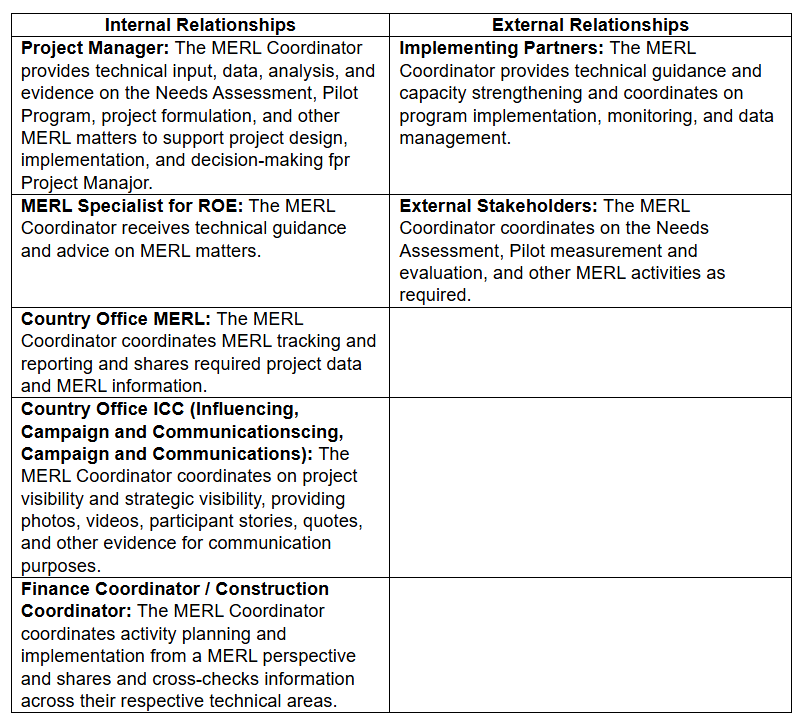
The MERL Coordinator is responsible for the MERL functions of Shikshya – Project Preparation Fund and projects implemented with top-up funding. Under the project, the main areas of responsibility are the Needs Assessment, Pilot Program, Evidence-Based Project Formulation, and Evidence-Based Reporting & Strategic Visibility. All project responsibilities are carried out under the direction and approval of the Project Manager, with technical guidance from the MERL Specialist for ROE on MERL matters.
Direct Line Manager: Project Manager
Dotted Line Manager: MERL Specialist for ROE (Providing technical guidance on MERL matters)
Budget Accountability: Management of NPR 1,750,000 allocated to the Needs Assessment under the Shikshya – Project Preparation Fund, subject to approval by the Project Manager.
Number of direct reports: 0
External relationships and representation: Coordinates with Implementing Partners on program implementation, monitoring, and data management and provides technical guidance and capacity strengthening as needed. Coordinates with external consultants and other stakeholders involved in the Needs Assessment and Pilot implementation and evaluation as required.
Project team: Works as part of a four-member project team comprising the Project Manager, Finance Coordinator, MERL Coordinator, and Construction Coordinator, with responsibility for the project’s MERL functions.
Level of Effort (LOE): 100% allocated to the Shikshya – Project Preparation Fund and projects implemented with top-up funding. Support to other projects or functions is limited to exceptional cases and requires prior coordination with the Project Manager.
Authority / technical guidance: All project responsibilities are carried out under the direction and approval of the Project Manager, with technical guidance from the MERL Specialist for ROE on MERL matters.
Key relationships
The MERL Coordinator engages with key internal and external stakeholders on MERL matters related to the Needs Assessment, Pilot Program, project formulation, reporting, and strategic visibility under the Shikshya – Project Preparation Fund and projects implemented with top-up funding.
Accountabilities
The MERL Coordinator is accountable for the following results to establish and use the evidence required for the formulation of the upcoming MOFA Japan-funded project,
1. Needs Assessment
Establish valid evidence on target areas and populations, priority issues, and intersectional needs to inform targeting and design of the upcoming project.
- Design the methodology, data requirements, and quantitative and qualitative methods.
- Manage data collection, verify data quality, and analyze the evidence collected.
- Identify target areas and populations, priority issues, and intersectional needs, and consolidate the findings as evidence for the Pilot Program and future project formulation.
2. Pilot Program
Validate the effectiveness of interventions and the conditions for their implementation through the design, implementation, monitoring, and evaluation of the Pilot Program.
- Provide MERL technical input to the design of interventions, expected results, Results Framework / Logframe, indicators, and measurement methods based on the Needs Assessment findings.
- With the requirements of MOFA Japan, including No Change and Details, in view, verify alignment between approved activity details, actual implementation, and reported data; identify discrepancies across records and data sources; and ensure corrective follow-up as required. This includes participant numbers and breakdowns, number of sessions, attendance, outputs, and other activity-level information.
Assess change and effectiveness using quantitative and qualitative methods and determine what works, for whom, under what conditions, and to what extent.
3. Evidence-Based Project Formulation
Integrate evidence from the Needs Assessment and Pilot Program into the design and formulation of the upcoming project.
- Analyze evidence from the Needs Assessment and Pilot Program and provide technical input to targeting, priority issues, approaches, and interventions.
- Provide evidence-based technical input to the design of the results logic, Results Framework / Logframe, indicators, and measurement approach.
- Organize data, analysis, and evidence required for proposal development and support the Project Manager in evidence-based project formulation.
4. Evidence-Based Reporting and Strategic Visibility
Use quantitative and qualitative evidence to clearly demonstrate project results and changes through reporting and strategic visibility.
- Manage and analyze evidence on activities, outputs, and outcomes and provide verified information for internal and donor reporting.
- Collect and document qualitative evidence, including photographs, participant stories, and quotes, with appropriate consent.
- Integrate quantitative and qualitative evidence and coordinate with ICC and other relevant teams to use verified project results and changes for reporting and strategic visibility.
5. Cross-Cutting Responsibility
- Coordinate with Implementing Partners and the project team on field-level implementation of program activities and required follow-up.
- Provide Implementing Partners with technical guidance and capacity strengthening on monitoring, data management, and MERL systems.
- Manage and update MERL information and data in project management systems such as SAP and PMERL.
- Provide accurate Nepali-English translation and consecutive interpretation as required during field visits, meetings, and stakeholder coordination.
Any other tasks as assigned by line manager in accordance to organizational mandate and priority.
- Ensures the full integration of Plan International’s global policies on Safeguarding Children, Program Participants, and Gender Equality and Inclusion (DEI) within their area of responsibility. This includes adherence to the policy principles, relevant Implementation Standards, and Guidelines. Key responsibilities involve ensuring that staff and associates are informed of and understand their obligations under these policies and Plan International’s Code of Conduct (CoC), their relevance to their specific roles, and that any concerns are promptly reported and managed in line with established procedures.
Technical expertise, skills and knowledge
The role requires the following technical expertise, knowledge and skills to deliver the above accountabilities,
Education qualification and experience
- Master’s degree in Social Sciences with at least three years of professional experience in MERL, research and/or evaluation in the development sector or a Bachelor’s Degree with minimum five years of experience
- Practical experience in development projects in Madhesh Province.
- Practical experience in field-level project implementation with Implementing Partners.
- Practical experience in collecting and documenting photographs, participant stories, quotes, and other evidence of project results for reporting and communications.
Knowledge
- Practical knowledge of MOFA Japan donor compliance, including No Change, No Extension, Details, Visibility, Sustainability, and accountability for both results and implementation processes.
- Professional knowledge of results-based MERL and quantitative and qualitative research and evaluation methodologies is added advantage
- Knowledge of evidence-based project design and formulation, including the relationships between evidence, targeting, intervention design, results logic, indicators, and measurement approaches.
Skills
- Ability to design and conduct Needs Assessments and Pilot measurement and evaluation and analyze quantitative and qualitative evidence.
- Ability to translate evidence from Needs Assessments and Pilot Programs into project formulation, including targeting, intervention design, results logic, and indicators.
- Ability to verify alignment between approved project details, actual implementation, and reported data, identify discrepancies, and ensure corrective follow-up.
- Ability to combine quantitative data and qualitative evidence to clearly demonstrate project results and changes through reporting and strategic visibility.
- Ability to use MS Office and project management systems, including SAP and PMERL, for MERL data management and reporting.
- Written and verbal communication skills in English and Nepali, including the ability to provide accurate Nepali-English translation and consecutive interpretation as required..
- Ability to analyze expenditures, implementation, and results, assess cost-effectiveness and cost-efficiency, and translate findings into financial input for project design and budget formulation.
- Ability to use MS Office, including Excel, and project management systems for financial management, analysis, and reporting.
- Written and verbal communication skills in English and Nepali, including the ability to provide accurate Nepali-English translation and consecutive interpretation as required.
Plan International’s Values in Practice
We are open and accountable
We create a climate of trust inside and outside the organisation by being open, honest and transparent. We hold ourselves and others to account for the decisions we make and for our impact on others, while doing what we say we will do.
We strive for lasting impact
We strive to achieve significant and lasting impact on the lives of children and young people, and to secure equality for girls. We challenge ourselves to be bold, courageous, responsive, focused and innovative.
We work well together
We succeed by working effectively with others, inside and outside the organisation, including our sponsors and donors. We actively support our colleagues, helping them to achieve their goals. We come together to create and implement solutions in our teams, across Plan International, with children, girls, young people, communities and our partners.
We are inclusive and empowering
We respect all people, appreciate differences and challenge inequality in our programmes and our workplace. We support children, girls and young people to increase their confidence and to change their own lives. We empower our staff to give their best and develop their potential.
Physical Environment
This position is based in Regional Office- East, Dhanusha, with frequent travel to field as necessary
Level of contact with children
High level: Frequent interaction with children
Location: Dhanusha (Regional Office- East)
Type of Role: Fixed-term employment until March 2028
Reports to: Project Manager- Direct, MERL Coordinator- Dotted
Grade: C2
Closing Date: 18 October 2026
Equality, diversity and inclusion is at the very heart of everything that Plan International stands for.
We want Plan International to reflect the diversity of the communities we work with, offering equal opportunities to everyone regardless of age, disability, gender reassignment, marriage and civil partnership, pregnancy and maternity, race, religion or belief, sex or sexual orientation.
Plan International is based on a culture of inclusivity and we strive to create a workplace environment that ensures every team, in every office, in every country, is rich in diverse people, thoughts, and ideas.
We foster an organisational culture that embraces our commitment to racial justice, gender equality, girls’ rights and inclusion.
Plan International believes that in a world where children face so many threats of harm, it is our duty to ensure that we, as an organisation, do everything we can to keep children safe. This means that we have particular responsibilities to children that we come into contact with and we must not contribute in any way to harming or placing children at risk.
A range of pre-employment checks will be undertaken in conformity with Plan International’s Safeguarding Children and Young People policy. Plan International also participates in the Inter Agency Misconduct Disclosure Scheme. In line with this scheme we will request information from applicants previous employers about any findings of sexual exploitation, sexual abuse and/or sexual harassment during employment, or incidents under investigation when the applicant left employment. By submitting an application, the job applicant confirms their understanding of these recruitment procedures.
Please note that Plan International will never send unsolicited emails requesting payment from candidates.
To apply for this job please visit career5.successfactors.eu.